
 By Mano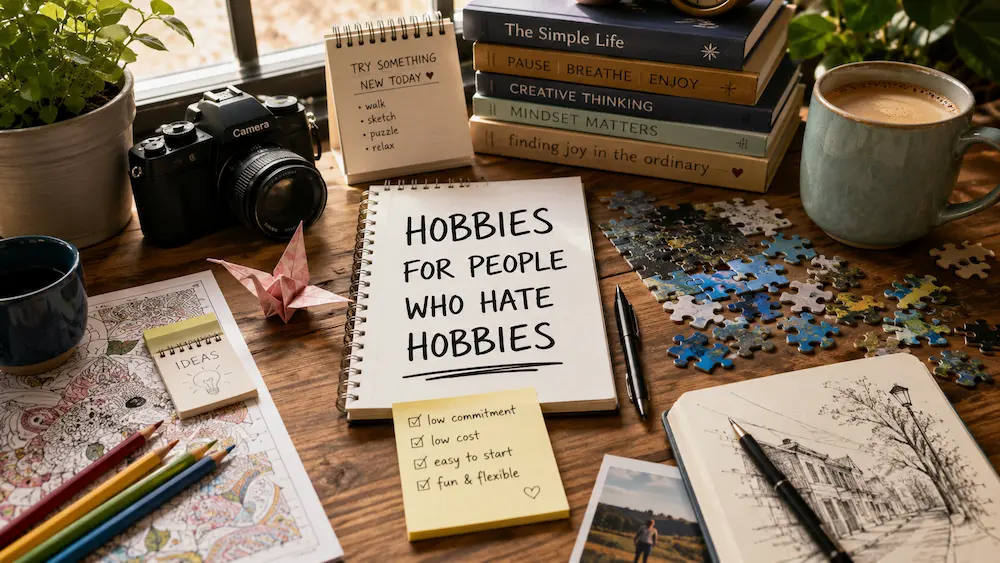
If every list of “fun hobbies” makes you want to close the tab, you may not need a better list. You may need a different kind of hobby.
Some people dislike activities that require hours of practice, expensive supplies, regular classes, or a commitment to becoming good at something. A hobby can be enjoyable without becoming a second job.
The trick is to choose something that fits your actual life.
A low-commitment hobby has a small starting cost in time, money, energy and attention.
It should be easy to begin, easy to stop, and easy to return to later. You should not need a dedicated room, a large collection of equipment or a weekly appointment.
A useful test is simple:
Could I try this once for 20 minutes without feeling like I’ve signed up for something?
If yes, it is worth testing.
You already have the camera. Give yourself a tiny challenge, such as photographing interesting doors, shadows, food or unusual objects during a walk.
A walk becomes more interesting when you give it a small mission: find a new street, photograph five things, listen to an album or explore a local park.
Crosswords, Sudoku, logic puzzles and jigsaw puzzles let you stop whenever you want. There is no schedule to maintain.
Paper is cheap, the workspace is tiny and individual projects can be completed quickly. You can learn one design without deciding to become an origami enthusiast.
You don’t need to “learn art” first. Draw whatever is in front of you for ten minutes. The point is paying attention, not producing gallery-worthy work.
Skip elaborate systems. Write one page, a few observations or even three sentences about your day. There is no correct format.
You can start without expensive binoculars. Learn to identify birds around your home or on ordinary walks using a reliable field guide or identification app.
Instead of taking on complicated recipes, choose one dish you have never made. If you like it, make it again. If not, move on.
One easy-to-manage plant is enough. You don’t need to turn your home into a greenhouse.
If finishing books feels like homework, try essays, short stories, comics, magazines or individual chapters. Reading does not have to mean completing a 400-page novel.
Ten minutes of vocabulary, listening or pronunciation can be enough for a session. You can stop after ten minutes without losing a larger project.
Small builds provide a clear beginning and end. You can also dismantle them and start again.
This combines walking with a simple search. It gives you somewhere to go and something to look for without requiring a formal class or team.
Adult coloring books require little preparation and offer a defined activity when you want to do something with your hands without learning a complicated skill.
You don’t need to become an art expert. Pick one exhibition, spend 30 minutes looking around and leave when you’re done.
That’s not necessarily failure.
The internet often treats hobbies as projects that must become part of your identity. They don’t have to.
Try an activity three times. If you still don’t look forward to it, drop it.
You may also discover that you like parts of a hobby rather than the hobby itself. Photography might lead to walking. Cooking might lead to learning about spices. Gardening might turn into growing herbs.
Follow the part you actually enjoy.
This is where many beginners make things harder than necessary.
Don’t buy a complete painting kit because you watched one painting video. Don’t purchase ten plants because gardening looks relaxing. Don’t buy expensive camera equipment before learning what you enjoy photographing.
Use what you already own first.
The goal of the first attempt is not to build a collection. It is to find out whether you want to do the activity again.
There is no rule saying your free time must produce a skill, achievement or finished product.
Research has found associations between hobby engagement and better mental-wellbeing measures, but that does not mean every person needs a hobby or that one activity treats a mental-health condition. The evidence is about associations, not a guaranteed outcome.
If walking, cooking, listening to music, visiting places, playing games or taking photographs makes your free time better, that can be enough.
Don’t ask:
“What hobby should I have?”
Ask:
- Do I want to be alone or around people?
- Do I want to use my hands or my mind?
- Do I want to move or sit?
- Do I have 10 minutes or two hours?
- Do I want a finished result?
- Do I want to learn something?
- How much money am I willing to spend?
- Can I stop without creating unfinished work?
Then test one activity.
You don’t need to find your lifelong hobby on the first attempt. You only need to find something you wouldn’t mind doing again next week.
- If you hate commitment, try puzzles or photography.
- If you hate spending money, try walking or sketching with paper you already have.
- If you hate socializing, try reading, journaling or origami.
- If you hate sitting still, try walking, birdwatching or geocaching.
- If you hate learning complicated skills, try coloring, cooking one new dish or photography.
- If you hate being unproductive, try cooking, gardening or building something.
A good hobby does not need to impress anyone. It only needs to make a small part of your free time feel worth having.