
 By Mano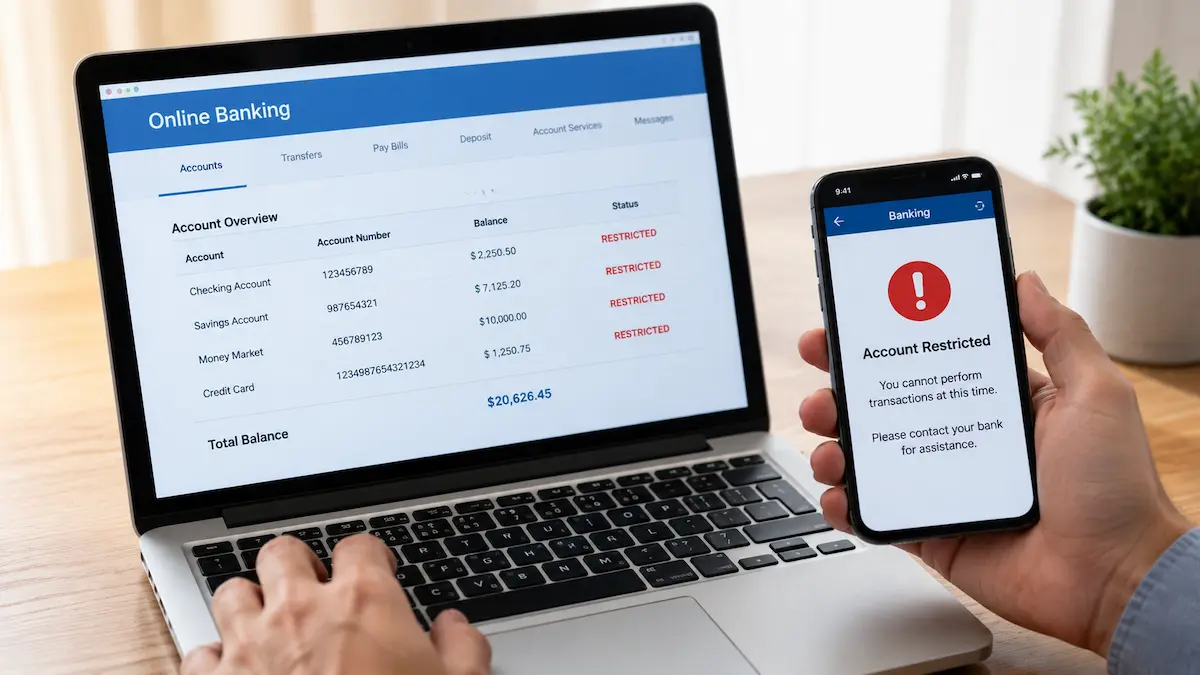
Usually, a restricted bank account can still receive money—but there is no universal rule. A bank may restrict only certain functions, such as withdrawals or outgoing transfers, while leaving incoming payments available. A broader freeze, legal order, sanctions block, or account closure can produce a different result.
The important question is not simply whether the account is “restricted.” It is what the bank has restricted.
An incoming payment can be credited to an account even when some outgoing transactions are blocked. But receiving a payment and being able to use that money are separate issues.
For example, a bank may allow an electronic payment to reach an account while preventing the account holder from withdrawing or transferring the funds. In the United States, Federal Reserve guidance treats ACH credits and wire transfers as electronic payments received for deposit, while funds-availability rules separately determine when deposited money must be available for withdrawal.
So a new deposit appearing in your balance does not necessarily mean you can spend it.
It may.
Payroll and other recurring electronic payments can continue when a restriction affects outgoing activity rather than incoming credits. But the result depends on the bank’s restriction and the reason it was applied.
If you’re expecting a paycheck, benefit payment, or another important deposit, don’t assume it will be accessible simply because the account remains open. Ask the bank whether incoming deposits are being accepted and whether newly credited funds will be available for withdrawal.
The same principle applies.
An incoming transfer may be accepted while outgoing transfers are disabled. But a bank can apply additional review to a particular transaction, and a more extensive freeze or legal restriction can change what happens.
That is why “restricted account” is not enough information to predict the result of every transfer.
Possibly, but there is another issue: deposit holds.
A check can be accepted for deposit without the money becoming immediately available. In the United States, Regulation CC establishes rules governing when certain deposited funds must be made available and permits specific types of holds in qualifying circumstances.
That means three things can happen at different stages:
- The bank accepts the deposit.
- The deposit appears in the account.
- The funds become available for withdrawal.
Those events are not necessarily simultaneous.
A more serious restriction can affect incoming funds too.
This can occur where the account is subject to a broad freeze, legal process, sanctions requirements, or another restriction that covers the funds themselves.
For example, an IRS bank levy freezes funds in the account when the levy is received. The IRS says money deposited after the levy normally is not affected by that particular levy, illustrating why the source and legal basis of a restriction matter.
OFAC sanctions are another distinct situation. Blocked funds are subject to specific rules and must be maintained in a blocked account from which only authorized debits may be made.
These situations should not be treated as ordinary bank-account restrictions.
These terms are often used loosely, but they can describe different situations.
| Status | What it can mean |
|---|---|
| Restricted | Some account functions have been limited |
| Frozen | Access or transactions may be broadly suspended |
| Blocked | Transactions may be prohibited because of a specific legal or regulatory requirement |
| Under review | The bank is examining activity, identity information, or another issue |
| Closed | The account relationship has ended |
A bank may use different wording from another institution. What matters is which functions are actually unavailable.
MoneyHelper notes that banks can freeze, block or suspend accounts for reasons including suspected fraud, unusual activity and legal situations.
Contact the bank through an official channel and ask three specific questions:
- Can incoming deposits still reach my account?
- Will the incoming funds be available for withdrawal?
- Is there a restriction on the payment type I’m expecting?
If the payment is important—such as payroll, a large transfer, or a time-sensitive refund—contact the sender as well if the bank says the payment could be rejected or held.
Do not rely on a text message, email, or phone number that claims to be from your bank. Use the number on your card, the bank’s official website, or its verified app.
Yes, a restricted bank account can often receive money, but “restricted” does not guarantee that every incoming payment will be accepted or that you will be able to use the funds. The outcome depends on the type and scope of the restriction, the payment method, and whether a legal or regulatory hold is involved.
If money is on the way, the safest answer comes from your bank: ask whether the payment will be accepted and whether the resulting balance will be available to you.