
 By Mano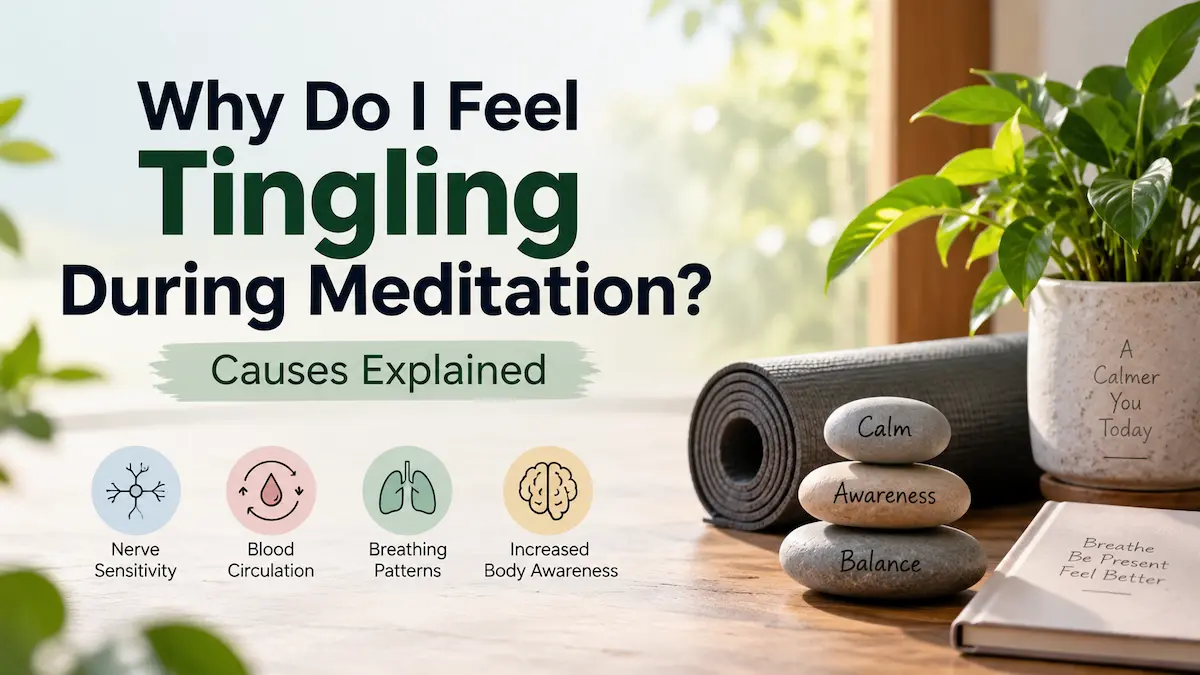
Tingling during meditation often has a straightforward explanation. Sitting still can temporarily put pressure on a nerve, meditation can make subtle body sensations easier to notice, and unusually fast or deep breathing can sometimes produce tingling of its own.
The medical term for a tingling, prickling or “pins and needles” sensation is paresthesia. A brief episode that disappears after changing position is different from tingling that keeps returning, persists outside meditation or comes with other neurological symptoms.
Paresthesia can feel like:
- pins and needles
- prickling
- buzzing
- mild burning
- numbness
- an “electric” sensation
Temporary paresthesia is common. Cleveland Clinic notes that body position can place pressure on a nerve or temporarily affect blood flow around it, causing a limb to “fall asleep.” The sensation generally improves after the pressure is removed.
That matters during meditation because remaining motionless can make the same thing happen in a foot, leg, hand or arm.
But posture isn’t the only possible explanation.
If the sensation develops mainly in a leg or foot after you have been sitting cross-legged or holding one position, posture is an obvious place to look first.
Pressure around a nerve can cause temporary numbness or pins and needles. Changing position releases that pressure and the sensation should gradually settle.
You do not need to endure painful numbness to meditate correctly.
Try:
- uncrossing or repositioning your legs
- changing the angle of your knees or hips
- supporting yourself with a suitable cushion
- meditating in a chair if floor sitting repeatedly causes numbness
A meditation posture should allow you to remain attentive without unnecessarily compressing a limb.
Sometimes nothing dramatic has happened physically—the sensation has simply become harder to ignore.
Meditation deliberately narrows or redirects attention. During breath awareness or a body scan, there are fewer competing sights, sounds and movements demanding attention. Tiny sensations that normally disappear into the background can become surprisingly vivid.
This fits with research on interoception, the perception of signals arising from within the body. Mindfulness research has examined changes in interoceptive awareness and activity involving the insula, an important brain region for processing internal bodily signals.
That does not prove that meditation “creates” every tingle. A more cautious interpretation is that focused attention can change what you notice.
This also helps explain a common experience: the tingling appears strongest in the exact body part you are concentrating on.
For the broader effects of the practice rather than unusual physical sensations, see our guide to meditation benefits.
Pay attention to how you are breathing.
Trying too hard to take exceptionally deep breaths—or breathing faster than usual—can lead to hyperventilation. This means breathing more than your body currently needs.
Tingling can accompany hyperventilation, particularly in the arms or around the mouth. Other clues can include:
- dizziness
- lightheadedness
- a racing or pounding heartbeat
- muscle spasms
- shortness of breath
If those symptoms begin during deliberate breath control, stop forcing the breath. Allow it to return to a comfortable, natural rhythm.
This distinction is important because “take deeper breaths” is not always the right response to tingling.
The location does not diagnose the cause, but the pattern can provide useful clues.
- Foot or leg: If it develops after sitting in one position and resolves when you move, temporary nerve pressure is a plausible explanation.
- Hand or arm: Check whether your wrist, elbow, shoulder or arm has been held in an awkward or compressed position.
- Around the mouth and hands: If this occurs together with rapid or unusually deep breathing, dizziness or lightheadedness, over-breathing deserves consideration.
- Wherever you direct attention: If a mild sensation becomes prominent specifically as you scan or focus on that body part, heightened awareness may be contributing.
- Whole body: A diffuse buzzing or vibrating feeling is harder to attribute to posture alone. First check the breathing pattern and whether there are accompanying symptoms rather than assuming a spiritual or neurological explanation.
What matters more than location alone is when the sensation starts, how long it lasts, what makes it stop and whether it occurs outside meditation.
A useful response is simple.
First, notice where the sensation is and whether anything feels compressed.
If your foot or leg has clearly gone numb, change position gently. Meditation does not require remaining completely motionless despite pain or loss of sensation.
Next, check your breathing. If you have been intentionally breathing very deeply or rapidly, return to normal breathing.
Then observe what happens.
Tingling that fades when posture or breathing changes gives you useful information about its likely trigger.
It can also help to notice:
- where the sensation occurs
- whether it is on one or both sides
- how long you had been sitting
- what posture you were using
- whether you were doing breathwork
- whether it stops after meditation
- whether it happens at other times
That pattern is more informative than trying to assign a meaning to a single episode.
Search for meditation tingling and you will quickly encounter explanations involving “energy,” vibrations, chakras or spiritual awakening.
Some Buddhist meditation traditions use the term pīti for pleasurable or energizing bodily sensations associated with certain states of concentration. Practitioners may describe warmth, tingling, waves or a feeling of energy.
That is a legitimate description within its religious and contemplative context.
It should not, however, replace a physiological explanation when one is available.
A numb foot caused by sitting position is still a numb foot. Tingling associated with over-breathing should not automatically be labeled an energy experience. And persistent unexplained paresthesia should not be assumed to represent spiritual progress.
You can respect a contemplative interpretation without treating it as a medical diagnosis.
A short-lived pins-and-needles sensation that appears after sitting awkwardly and disappears after moving is very different from persistent paresthesia.
Arrange medical evaluation if tingling:
- keeps returning without a clear positional trigger
- continues well after meditation
- occurs regularly when you are not meditating
- becomes progressively worse
- is painful
- is accompanied by persistent numbness or weakness
- interferes with normal movement or coordination
Tingling has many possible causes unrelated to meditation, including conditions affecting peripheral nerves. The fact that you first noticed a symptom while meditating does not prove that meditation caused it.
Sudden neurological symptoms—particularly sudden weakness or numbness affecting one side, difficulty speaking, severe loss of coordination or another acute neurological change—require urgent medical attention.
Is tingling during meditation normal?
Brief tingling can occur during meditation, particularly when posture puts temporary pressure on a nerve or focused attention makes an existing subtle sensation more noticeable. The pattern and duration matter more than the fact that it happened while meditating.
Why do my feet go numb when I meditate?
Sitting in one position can place pressure on nerves or surrounding tissues. If the numbness disappears after changing position, posture is a likely contributor.
Why do my hands tingle while meditating?
Check your arm, elbow and wrist position first. If both hands tingle while you are also breathing very deeply or rapidly, consider whether you may be over-breathing.
Can deep breathing cause tingling?
Yes. Excessive or rapid breathing can cause hyperventilation, which can produce tingling, particularly in the arms or around the mouth, along with symptoms such as dizziness or lightheadedness.
Should I ignore tingling and keep meditating?
Not automatically. Mild sensations can simply be observed, but painful numbness or clear positional compression is a reasonable reason to adjust your posture. Persistent or unexplained symptoms deserve medical attention rather than being pushed through.
Does tingling mean meditation is working?
Not necessarily. Tingling is a physical sensation, not a reliable measure of meditation quality or progress. It may reflect posture, breathing, increased awareness or another cause.
Is tingling a spiritual sign?
Some contemplative traditions interpret certain pleasant energetic sensations within their own frameworks, including the Buddhist concept of pīti. Science cannot establish from the sensation alone that a spiritual event has occurred. Physical causes should not be overlooked.
If tingling appears only while you sit in a particular position and disappears after you move, temporary positional paresthesia is a reasonable explanation.
If it emerges while you are deliberately breathing deeply or rapidly—especially with dizziness or tingling around your mouth—check the breathing pattern.
If the sensation becomes obvious mainly when you focus closely on your body, increased awareness may explain why you suddenly notice something that was previously below your attention.
And if the tingling persists, repeatedly returns outside meditation or comes with weakness, significant pain or other neurological changes, treat it as a health symptom rather than a meditation milestone and seek appropriate medical evaluation.